Improve Coil Line Productivity And Save On Roll Maintenance Costs
Unique Construction Offers Savings And Performance Advantages Over Conventional Rolls
EIL mill rolls are made of non-woven synthetic fiber discs bonded together with a tough flexible adhesive. The result is a resilient roll that is gouge resistant and self-healing. On continuous coil lines and sheet processing lines, you can expect longer life and better performance than rubber, felt, and urethane rolls. For example, have lasted up to 100 times longer than rubber rolls.
Unlike dense rubber, EIL non-woven mill rolls are also porous with up to 40 percent void volume for absorption that helps in wringing and tensioning. Porosity also helps in applying uniform lubricant thickness.
In wringer, oiler, tension/bridle, or support roll applications, EIL non-woven mill rolls can help improve the productivity and cost efficiency of line operations with fewer defects from “carry out” or slippage.
EIL non-woven mill rolls outperform conventional rubber rolls.
| EIL Non-woven Mill Rolls | Rubber Rolls |
| Compressible; resist cutting, gouging for more up time compared to rubber rolls. | Non-compressible; susceptible to cuts. |
| Porous, open surface for consistent strip contact even when wet. | Non-porous, closed surface. Can hydroplane when wet. |
| Repairable for better return on your investment. | Non-repairable. |
| Self-healing for more up time compared to rubber rolls. | Cuts propagate. |
| High coefficient of friction on many surfaces for better material control. | Low coefficient of friction on web/oiled surface conditions |
Higher Performance Under Pressure
EIL non-woven mill rolls and conventional rubber rolls react differently at the same pressure levels.
Rubber rolls are essentially non-compressible, so the rubber bulges out on each side of the nip — as shown below.
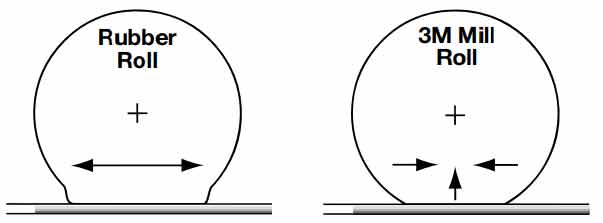
This outward pressure causes tensile stresses that can enlarge cuts and gouges caused by metal slivers, strip splices, and production debris. After metal slivers stick into a rubber roll, the slivers will scratch the continuous metal strip that follows, causing surface defects. Splices and production debris can easily cut or gouge rubber rolls, resulting in increased “carry out” in wringing operations. Baths and rinses become contaminated as a result of this “carry out”. As this problem grows, the final result is having to stop the production line to change rolls.
with their void volume and non-woven porosity are slightly compressible. Under pressure, the roll increases in density at the nip. And as density increases, the material compresses inwardly, causing the roll to resist cuts and gouges. This compressive stress allows cuts to heal themselves as the compressive forces push the sides of the cut closed. This means that EIL non-woven mill rolls are less prone to damage, which keeps production lines moving, defects low, and productivity high.
Easy to Repair & Re-use
While EIL non-woven mill rolls resist cuts and gouges and are selfhealing, they still can be damaged by major irregularities in the strip surface. Sharp edges from a break in the strip, for example, could severely cut the roll.
Repairs can be performed easily on site or at the distributor’s facility, making it unnecessary to inventory large numbers of replacement rolls as spares.
If severe damage occurs, the damaged portion of the roll can be removed from the shaft and repaired within 1 to 2 hours.
Proven Effective In A Wide Variety Of Applications
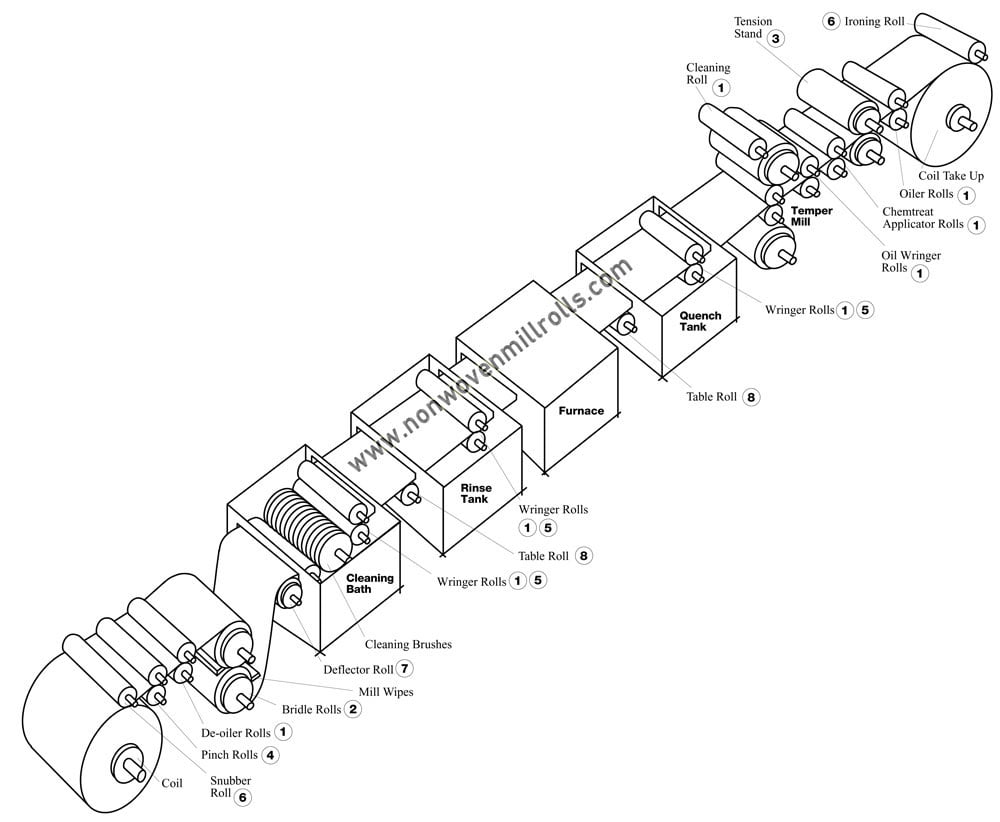
| Application | EIL Nonwoven Mill Roll | |
| 1. Wringer roll Oiler roll Oil wringer roll Cleaning roll De-oiler roll | Acid 0-2 pH Neutral 2-10 pH Caustic 10-14 pH Chemtreat Oiler/de-oiler | Type C, CX Neutral Type C, CX, D Type CX Neutral |
| 2. Bridle roll | Neutral , RK | |
| 3. Tension stand roll | Neutral | |
| 4. Pinch roll Feed roll | Environment dependent | All |
| 5. Steering roll | Environment dependent | All |
| 6. Snubber roll Ironing roll | Neutral , RK | |
| 7. Deflector roll | Neutral , RK | |
| 8. Table roll Carrier roll Swing Arm roll | Environment dependent | All |
| 9. Measuring roll | Environment dependent | All |
Higher Coefficient Of Friction For Faster Line Speed And More
With a higher coefficient of friction than rubber, urethane, or carbide coated rolls, EIL nonwoven mill rolls can increase tension levels for tighter coils. Compared to rubber, for example, tension can be up to 45 times greater. Tighter coils can provide the following benefits:
- Faster line speed with less slippage
- Fewer defects related to slippage
- Minimized sag
- Better line control
- Straighter edge registry
- Reduced droop and movement in annealing furnaces
When used as tension and bridle rolls, EIL nonwoven mill rolls provide a coefficient of friction 50 percent higher than rubber or urethane on dry steel, and more than 40 times higher on oiled steel. And you don’t need to texture the surface like rubber or urethane to improve friction.
| Material Condition | EIL Mill Rolls | Rubber Rolls |
| Dry Steel | .52 | .36 |
| Oiled Steel | .36 | .01 |
| Dry Aluminum | .52 | .36 |
| Oiled Aluminum | .23 | .01 |
Compressible Nonwoven Mill Rolls
Tight Contact for Consistent Wringing, Oiling, and De-oiling
Wringing
EIL Nonwoven Mill Rolls are slightly compressible with a porous open surface. With the compressible, sponge-like characteristic,the rolls conform to the smallest variations in gauge thickness to maintain consistent tight contact across the strip. This tight contact helps assure exceptionally uniform wringing. Strips emerge drier from the rinse tank, and in some cases, users have found up to a 95 percent reduction in solution “carry through” compared with conventional rubber rolls. And the porous surface absorbs fluid to greatly reduce the chance of hydroplaning which can cause slippage.
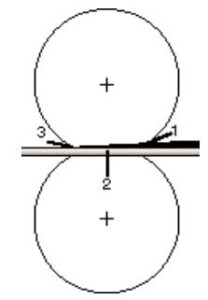
- Porous roll absorbs solution to relieve hydraulic pressure while maintaining tight contact with the metal strip.
- Roll is compressed to near zero at the nip center, creating a seal which is restored with each revolution of the roll.
- The porous surface reopens as compression decreases. The spongelike action removes residual liquid from the strip.
Oiling and De-oiling
With tight contact, EIL nonwoven mill rolls meter and apply lubricants consistently and uniformly. And operators can remove excessprotectant oils on incoming metal strip. This “de-oiling”helps reduce costs and improve capabilities in the caustic cleaner.
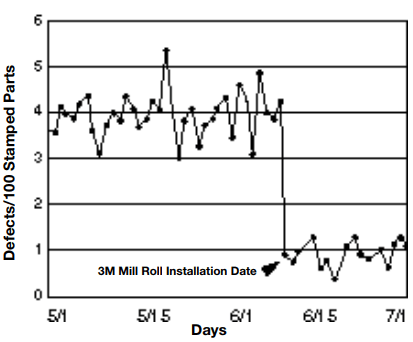
Defects reduced
The results of EIL nonwoven mill rolls replacing rubber rolls in an automotive stamping operation are shown below. With the more effective wringing action of the EIL rolls, defects were reduced from four per hundred stampings to approximately one per hundred.
Broad Operational Pressure Range
EIL nonwoven mill rolls can be used within a wide range of pressures and temperatures and still provide excellent wringing. Wringing has been evaluated under a wide range of operating pressures. Nip pressure as measured in pounds/linear inch of roll width (PLI) is the key parameter.
Neutral, RK Rolls
Maximum continuous operating temperature for EIL Neutral and RK rolls is 285°F (141°C). EIL Neutral roll maximum operating pressure depends on roll density. RK roll maximum PLI is 100.
C, CX, D Rolls
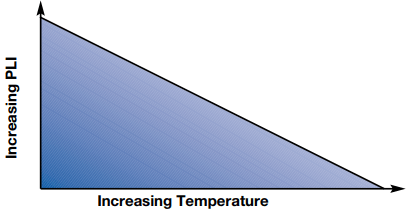
Types C, CX and D maximum operating pressures are dependent on operating temperatures. For these rolls there is an inverse relationship between temperature and pressure as indicated in the graph above.
EIL Nonwoven Mill Rolls Availability & Charactoristics
| Product | pH Range | Density | Typical Applications | |||
| 3 | 5 | 7 | 9 | |||
| Neutral | 2-10 | X | X | X | X | *Wringing *Ironing *Oil appplication *Bridle *Tensioning *Steering rolls *Deflector *Snubber *De-oiling *Metering |
| Type C | 0-14 | X | X | *Wringing feed rolls in a chemical environment with no petroleum | ||
| Type CX | 0-14 | X | X | *Wringing applicator for chemtreat solutions | ||
| Type D | 0-14 | X | X | *Wringing *Metering *Sunbber *Steering rolls | ||
| RK | 2-10 | NA | *Bridle * Snubber *Table rolls | |||